







$48 Million Cannabis Bust on I-78: What It Means for New Jersey Drug Trafficking Laws
New Jersey’s Largest Cannabis Seizure: Legal Implications for Drug Trafficking Defendants
 New Jersey State Police made a significant cannabis bust in the state’s history after a traffic stop of a commercial vehicle driving along Interstate 78 east in Greenwich Township, Warren County. Police stopped the car on September 10, 2025, and the arrest went public a week later.
Mobile Safe Freight Unit police officers stopped the vehicle for inspection. A search of the vehicle turned up a vast variety of cannabis products. The load is estimated to have a street value of $48 million. The shipment consisted of 7,600 lbs. of hydroponic cannabis, 44,400 THC vape cartridges, 9,500 units of THC gummy packages, 50 liters of cannabis resin, and 80 packages of THC-infused cigarettes.
The driver, a 45-year-old man, and the passenger, a 48-year-old man from Irving, Texas, were indicted for possession of a controlled dangerous substance with the intent to distribute, possession of a controlled dangerous substance, and a count of conspiracy. They are currently detained in the Warren County Correctional Center for a detention hearing.
Legalization of recreational cannabis by the State of New Jersey has failed to eliminate stern punishment for unauthorized possession without a license and mass-level trafficking. Although the law allows adults to keep limited stocks of marijuana for personal use, transportation, or sales outside the legalized market is a felony offense. Trafficking cannabis from state to state or keeping it for the purpose of delivering the same without a legitimate license could be a serious felony offense, even if the substance itself is legalized elsewhere.
Possession for distribution and conspiracy offenses carry the potential for years in prison, significant fines, and long-term criminal records. Prosecutors are typically aggressive in bringing such cases when the size of the product suggests organized transportation or commercial intent.
Our office has extensive experience defending individuals accused of drug crimes in Sussex and Warren Counties. We know how police build these types of cases and how the State prosecutes them. By inspecting the legality of the stop and the search and seizure, we safeguard the rights of the defendant and challenge any deprivation of due process.
New Jersey Cannabis Regulations and N.J.S.A. 2C:35-5 Distribution Laws
New Jersey cannabis laws divide regulated market transactions from criminal smuggling. Upon the state’s 2021 legalization of recreational cannabis, a legally licensed network of retailing, processing, and cultivation is governed by the Cannabis Regulatory, Enforcement Assistance, and Marketplace Modernization Act. Licensed entities that are authorized by the Cannabis Regulatory Commission are the only entities that are permitted to cultivate, transport, or sell cannabis products in the marketplace that is controlled by the state.
Possession or distribution outside this legally authorized arrangement remains a criminal offense pursuant to the statute of N.J.S.A. 2C:35-5 that controls the manufacturing, distribution, and possession for the purpose of distributing controlled dangerous substances. The offense is graded by the quantity involved. A possession of over 25 pounds of marijuana or equivalents in THC products constitutes a first-degree offense that is punishable by a maximum 20-year term in the state prison and fines of a maximum of $300,000. Smaller amounts may evoke second- or third-degree offenses that carry the potential of imprisoning criminals and substantial fines.
Licensed stores are governed tightly for the safe quality of their goods, taxes, and conformity to advertising and transportation laws. Interstate or unlicensed activity falls outside this system and is criminalized. The federal law compounds the issue—the Controlled Substances Act categorizes cannabis as a felony across the nation. Transporting it between states, even between states where cannabis has been legalized for medicinal or recreational purposes, is considered trafficking in drugs.
Organized distribution or large-scale trafficking efforts are subjected to stiffer penalties that are a testament to the state’s attempt to discourage commercial-level offenses. Multimillion-dollar seizures are commonly prosecuted at the state and federal levels and may result in forfeiture actions.
How Cannabis Quantity Determines Your Charges: First, Second, and Third-Degree Offenses
Drug possession
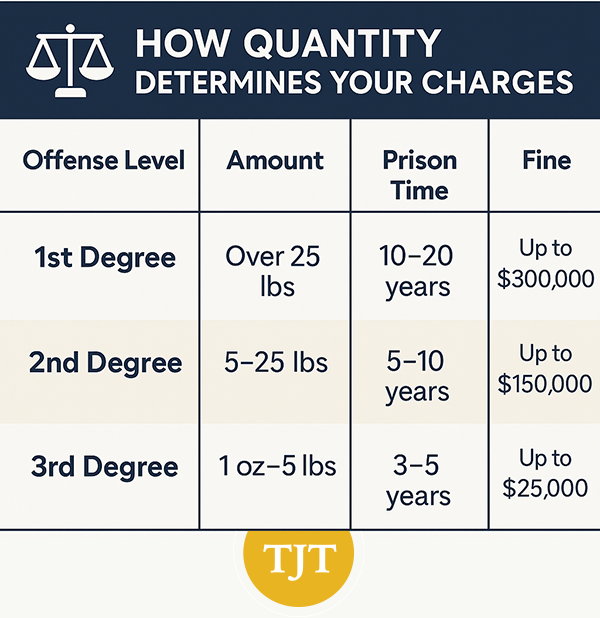 Under N.J.S.A. 2C:35-5, a New Jersey distribution offense will often depend to a significant degree on the nature and the amount of the substance. With THC products and marijuana, distribution or possession when it is your intention to distribute will be a first-degree, second-degree, or third-degree offense.
A first-degree charge follows when the crime is for over 25 pounds of cannabis, 50 or more cannabis plants, or the related THC weight in processed cannabis. It constitutes a 10 to 20-year prison term and fines that could exceed $300,000. This will most likely attract additional scrutiny by prosecutors and may involve cooperation with the federal agencies where interstate trafficking is suspected.
A second-degree charge includes amounts that are between five to twenty-five pounds. The sentence is between 5 and 10 years in prison and fines of $150,000 or less. Judges will view these crimes as serious felonies even for first offenses, and the DA will often resist the acceptance of lower pleas without serious mitigators.
A third-degree offense carries a charge of a single ounce to less than five pounds. Convictions can bring 3 to 5 years in prison and a $25,000 maximum fine, but first-time offenders can receive probation or alternative sentences when represented properly.
In some trafficking cases, the defendant must meet a mandatory minimum sentence under the No Early Release Act (NERA), serving no less than 85% of the sentence to be eligible for parole. Although NERA does not automatically attach to all drug offenses, it can become attached to offenses that include violence, organized trafficking, or recidivism and will significantly increase the time served.
Conspiracy charges under N.J.S.A. 2C:5-2 are standard fare in multi-defendant cases. Prosecutors use the statute to charge each member for the aggregate activity of the group. Even accused participants who took a marginal role, such as a driver or lookout, can end up being charged equally to the master traffickers if the state proves a common plan or purpose.
Quantity is the most significant factor in establishing charge severity and sentencing exposure. Other aggravators, such as distributing around a zone of a school, a public park, or a public housing building, elevate the penalty, impose mandatory minimums, and restrict plea bargaining. Such enhancements are designed to discourage distribution in child- and family-populated areas but also afford the prosecutor extensive bargaining power.
Was Your Commercial Vehicle Search Legal? Understanding Search and Seizure Protections in NJ
Both the federal and New Jersey statutes authorize state police officers and commercial enforcement entities such as the Mobile Safe Freight Unit to stop commercial vehicles for the purpose of verification of licensure, weight requirements, and manifests of freight. Administrative inspections by the state’s regulations for carrier safety are allowable and may or may not rely upon probable cause.
Once a stop commences, the officer’s authority extends to the purpose for which the inspection is conducted. Officers may broaden their questioning if criminal activity comes into view, such as discrepancies in travel logs or observable contraband. The odor of marijuana, either burned or raw, by itself does not establish reasonable suspicion to justify a continued stop, nor probable cause to conduct a search, in a marijuana possession case. However, when there is a suspicion of large quantities being distributed, the smell of marijuana or the use of sniffer dogs is permitted.
The Fourth Amendment safeguards drivers against unreasonable seizures and searches so that evidence gathered outside the legal parameters of a stop may be challenged. If the court determines that the search is unconstitutional, all the evidence that has been confiscated may be excluded from a trial and severely hinder the prospects of the prosecution.
The Safe Freight Unit has wide latitude to inspect commercial freight for both safety and anti-trafficking purposes. The troopers are specially trained to look for secret compartments, false manifests, and evidence of narcotics transportation. Nevertheless, their powers are constrained by the limits of the Constitution. Detentions that shift over abruptly from inspection for criminal purposes, or that are based on mere generalized suspicion, are susceptible to challenges of suppression.
Defense lawyers will closely scrutinize the timeline of the contact, officer reports, and body-camera footage to see if the search was reasonable and if probable cause actually existed prior to the initiation of the search.
Attacking the Prosecution’s Case: Knowledge, Intent, and Constructive Possession
In seizures where a large quantity of cannabis has been involved, defense tactics are directed towards factual and procedural challenges. A typical defense technique challenges knowledge and intent. The prosecution has to establish that the defendant has knowledge of the contraband and the intention to sell it. Constructive possession is also the object of scrutiny. A defendant does not have to actually have the drugs, but the state has to prove control or dominion over the contraband. Defense attorneys will generally challenge evidence that ties the defendant to the vehicle, the merchandise, and the chain of command of the operation in order to challenge claims of constructive possession.
Issues of search and seizure also have further possible defenses. Lawyers inquire whether the commercial search went further than its proper legal boundary, whether probable cause truly existed, and whether procedural blunders occurred. Motions to suppress are often key because suppressed evidence may damage the entire state’s case.
Negotiations with prosecutors can also play a key role. Early intervention, including pre-indictment discussions, can lead to reduced charges, plea agreements, or alternative sentencing such as probation, drug treatment programs, or community service. For first-time offenders, programs like Pretrial Intervention (PTI) or conditional discharge may be available options. Attorneys may scrutinize drug quantity calculations and valuation methods, challenging overstated weight or THC content, which directly impacts sentencing exposure under N.J.S.A. 2C:35-5.
In significant trafficking cases, cooperation with police may also lead to additional charge reductions. Defendants who offer significant assistance in active investigations are sometimes able to receive sentence reductions or escape mandatory minimums. Each of these options needs to be implemented with careful timing and coordination because early, skilled legal action often dictates the final result.
How New Jersey Decides Pre-Trial Detention for Drug Trafficking Defendants
New Jersey has a pre-trial and bail system that attempts to strike a balance between the need for community security and the presumption of innocence. Judges look to see if a defendant is a flight risk or is a danger to the community when deciding bond restrictions, including bail. For serious drug trafficking offenses, the court has a detention hearing to weigh whether pre-trial release is appropriate.
The court in these hearings is directed by the Public Safety Assessment (PSA). The PSA considers the history of prior criminal activity, the nature and extent of the offense that has been charged, connection to the community, and the likelihood of court appearance. Mass distribution cases, particularly the multi-million-dollar seizures of narcotics, overwhelmingly favor denial of release due to the danger to the community for purposes of safeguarding the community and the possibility of additional criminal activity.
Release may be promoted by the defense attorney in the demonstration of stable connections to the community, stable employment, no prior conviction, and agreement to comply with pre-trial supervision. Release conditions may include electronic monitoring, travel restriction, periodic contacts with pre-trial services, and limitation of contacts with co-defendants or other witnesses. This enables the defendants to remain in the community while having supervision.
During the detention hearing, the prosecution bears the burden of proving by clear and convincing evidence that no combination of release conditions can reasonably mitigate the defendant’s risk. The defense, meanwhile, presents mitigating factors and may challenge the accuracy or weight of the PSA assessment. Judges evaluate all evidence and testimony before deciding whether detention or conditional release better serves public safety and the integrity of the judicial process.
Out-of-State Defendants and Multi-Jurisdictional Drug Trafficking Defense
 In-state cannabis trafficking may evoke the possibility of federal jurisdiction. Interstate transportation of large amounts of marijuana or THC products runs afoul of the federal Controlled Substances Act because cannabis remains a Schedule I substance. If evidence indicates that the distribution has a reach beyond the borders of New Jersey, a possibility for federal prosecutors to bring charges is raised or brought in lieu of state-level charges.
Defendants are subject to concurrent or distinct state and federal court action. Federal cases have unique rules, procedures, and sentencing protocols. Convictions in the federal court commonly entail higher sentences, increased stringent mandatory minimum sentences, and fewer parole options than state convictions. Federal sentences also take into consideration leadership roles in an operation, previous sentences, and the aggregate number of controlled substances brought into the jurisdiction.
Out-of-state defendants, such as those in the Greenwich Township traffic stop, face additional challenges. They may be subject to extradition to New Jersey to face charges, requiring coordination between jurisdictions and careful legal planning. Defense strategies often involve multi-jurisdictional coordination to manage overlapping investigations, ensure proper representation, and address potential conflicts between state and federal cases.
Defense lawyers must analyze the standard of evidence, procedural law, and possible sentences while safeguarding their client’s interests in both jurisdictions. For big-trafficking cases, early consultation and experienced counsel play a pivotal role in reducing exposure, investigating the possibility of a plea or cooperation, and achieving a homogeneous defense strategy for all jurisdictions.
Fight Your Cannabis Trafficking Charges with Skilled Warren County Attorneys
Our office has considerable experience representing persons charged with serious drug offenses in Warren and Sussex Counties. We have represented defendants accused of serious possession, distribution, and trafficking offenses that are part of large operations and multi-defendant cases. Our lawyers have experience making constitutional claims, bringing suppression motions, and settling cases that advance the rights of the client and reduce possible punishment. We offer full defense services throughout the life of a case. This encompasses representation for detention hearings, grand jury presentations, and advocacy for trial when called for. We work with our clients to evaluate all the defenses possible, confront invalid searches or seizures, and create defense strategies specific to the facts of the case.
Defendants for criminal charges involving THC or marijuana products or for other controlled drugs might consider using a free, confidential consultation to examine their facts and options. Call 973.755.1695 or contact us today to speak with an experienced Warren County drug trafficking defense attorney. Immediate action is particularly critical for the protection of constitutional rights, the preservation of the possibility of reduced charges, and the establishment of a powerful defense for felony drug cases. For those concerned about long-term criminal records, we can also discuss expungement options for eligible cases.
Our office covers the complete spectrum of services for clients accused of drug offenses, dealing equally with state and federal cases. We represent clients against charges of drug possession and distribution, such as those that involve mass trafficking. Our lawyers are skilled in the challenge of search and seizure concerns, especially those that result when a commercial vehicle is stopped, and also in the assertion of Fourth Amendment defenses for evidence integrity’s sake.
We advocate for clients during pre-trial detention hearings by leveraging New Jersey bail reform expertise to negotiate reasonable release conditions. For multi-defendant cases, we develop defenses for conspiracy charges so that the rights of the individual client are individually protected. When federal charges arise, our firm offers federal criminal defense, integrating strategies between jurisdictions. We advocate for clients during grand jury hearings, providing pre-indictment advocacy and early intervention. Our lawyers are experienced in motion work, such as suppression motions and pre-trial litigation of all kinds that are meant to exclude or constrain illegitimately obtained evidence.
Ultimately, we represent defense services for serious felony drug charges in Warren County Superior Court by advocating vehemently for the very best possible outcomes for our clients. Every case receives individual attention, thorough preparation, and meticulous planning to protect liberty and future opportunities. Don’t wait—call 973.755.1695 or contact us online for your free consultation.